History & Legacy of the Association
The journey of the Jalpaiguri Dabgram Industries Owners’ Welfare Association (JDIOWA) —it is a testament to collective courage, shared responsibility, and the unwavering determination of entrepreneurs who chose unity to make the environment of the Dabgram Industrial Park industrial growth conducive and served silently. The story of JDIOWA is not merely the history of an organization, it is the collective endeavour that transformed an industrial belt into a self-sustained model of governance.
In the moments of challenges, we always stand united. We never are ununited during any crisis moment for common cause. We used to raise one strong, fearless, and resounding voice against any unjust or arbitrary official action. We ensured that no member stood alone, unheard, or unsupported.
More than an association, JDIOWA members work shoulder to shoulder together as a single family and to boost the spirit of entrepreneurs, working to protect, serve, and build their own future business.
JDIOWA's Journey
The Beginning of an Industrial Vision
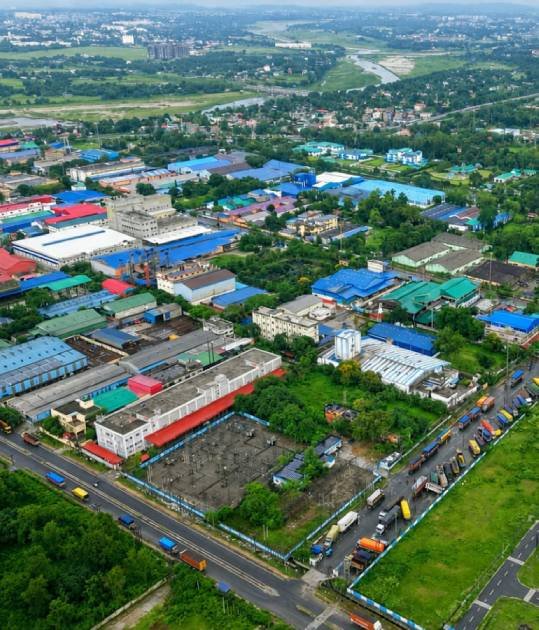
The Dabgram Industrial Park was promoted by two Government of West Bengal parastatals namely West Bengal Small Industries Development Corporation Limited (WBSIDCL) and West Bengal Industrial Infrastructure Development Corporation (WBIIDC)—making it the only industrial location in the state where both parastatals established industrial parks at a single location to promote Micro, Small, and Medium Enterprises (MSMEs). Initially the part promoted by the WBIIDC was called Dabgram Industrial Growth Centre and that of WBSIDCL was called Dabgram Industrial Estate. Later on, both the growth centre & estates are termed as Dabgram Industrial Park.
Industrial activities in this belt began in the late 1980s. By the early 1990s, around 15–20 industrial units were operational. While the entrepreneurial spirit was strong, the industrial environment of these newly established industrial parks was not so favourable for industrial growth due to some infrastructural issues.
Challenges Faced by the Early Entrepreneurs
The initial phase of industrialization at Dabgram had some practical difficulties. Unit owners faced persistent issues such as:
- Theft and robbery
- Extortion and coercion
- Oppression by building material supplier and contractor syndicates
- Unwarranted interference in employment matters
- Security threats arising from unregulated public activity as there was no boundary wall and entry & exit gates in both the industrial parks.
- Improper facility of roads, lights, drainage system, security etc.
Operating in isolation made it difficult for individual entrepreneurs to resist these adversities. It was during this period that the collective realization emerged— only unity could ensure survival and growth.
Emergence of the Dabgram Industrial Joint Committee
In 1993, the existing unit owners of that time came together to form an informal body named as Dabgram Industrial Joint Committee. Though it had no official recognition, it carried a clear purpose—to protect the industries from all types of adversities, to represent the units to the respective authorities and to work as an ambassador to make these industrial parks growth friendly.
Through persistent engagement with local civil administration, police authorities, and the industry departments, the Joint Committee succeeded in drawing attention to the challenges faced by the industrial community. Gradually, relief from several pressing issues was achieved, strengthening the belief that unity could transform vulnerability into stability for industrial growth.
Establishment of JDIOWA – Our Domicile
Driven by the vision of long-term sustainability and encouraged by the success of the Dabgram Industrial Joint Committee's initiative to protect the interests of the industrialists of this area, the industrial community proceeded to get the shelter of a joint forum and established an Association for the welfare of its members.
Thus, in 1997, the Jalpaiguri Dabgram Industries Owners' Welfare Association (JDIOWA) was formed and subsequently registered under the W.B. Societies Act XXVI 1961 in 1999.
From that moment onward, the Association committed itself to:
- Protecting the interests of industrial units
- Supporting compliance and infrastructure development
- Creating a peaceful and growth-oriented industrial environment
- Developing Dabgram Industrial Park as a Model Industrial Belt
- Serving both present and future entrepreneurs of Dabgram Industrial Park
Subsequently, the Association took over the operation & maintenance charge from WBIIDC and WBSIDC by executing formal agreements. What began as a defensive response to adversity evolved into a structured movement for industrial empowerment.
Transformation into a Model Industrial Belt
With improving security, administrative coordination, and a supportive ecosystem fostered by the Association, the Dabgram Industrial Park witnessed rapid industrial expansion.
- A large number of industrial units were established over time
- Not a single square inch of land in both WBSIDC and WBIIDC sectors is unallotted
- To meet rising demand, Dabgram Industrial Park Phase II and Phase III were developed by WBSIDC
- Phase IV and Phase V are currently in the developing stage
The region gradually transformed from a struggling industrial pocket into a vibrant and fully utilized industrial hub.
Emerging Concerns and the Road to Self-Governance
Growth brought new responsibilities. Unauthorized roadside establishments and gathering of anti-social elements began posing safety and security risks to the Industrial Growth Centre. Simultaneously, WBSIDC began pressing the Association to take over maintenance, day-to-day administration, and essential services of the Dabgram Industrial Estate, as permitted under lease deed clauses. Over time, WBSIDC significantly reduced its maintenance activities, increasing the urgency for action.
These issues compelled the Association's leadership to confront a defining question—should the entrepreneurs themselves take charge of their collective future? After extensive deliberations across multiple executive committee meetings, a unanimous resolution emerged. Recognizing that all enterprises operated on long-term leasehold land and would remain rooted in Dabgram for decades, the Association resolved to take responsibility for:
- Safety and security
- Essential services including maintenance of built-up infrastructure
- Day-to-day administration
- Long-term sustainability of the industrial belt
This decision marked a turning point—from dependence to self-governance, from uncertainty to collective stewardship. On 05 November 2014, JDIOWA formally took over the operation and maintenance responsibility from WBSIDC, becoming the first industrial association in West Bengal to do so.
A Landmark Recognition
On 17 December 2019, WBIIDC handed over the operation and maintenance responsibility after observing JDIOWA's effective governance—an exceptional recognition without prior lease provision—also making JDIOWA the first industrial association in West Bengal to take over charge of an industrial growth centre promoted by WBIIDC.
- 12 May 2011 – Proposal to WBIIDC for entry/exit gates, guard rooms, fencing, and traffic regulation, with JDIOWA offering full operational control at its own cost
- 2012–2013 – Multiple consultations with plot holders of WBIIDC to build consensus
- 28 October 2013 – WBIIDC officially handed over gate operations to JDIOWA
Leadership, Growth and Legacy
The Executive Committee, led by the President, played a decisive and proactive role throughout this journey, supported wholeheartedly by the general members. Initially there were 7 Executive Committee members; as membership strength grew, this was enhanced to 11, and today, with further growth, JDIOWA is governed by a 15-member Executive Committee—demonstrating collective leadership at every level.
What began with 15–20 units now benefits approximately 125+ industrial units and stakeholders through prevention of losses from insecurity and disorder, clean infrastructure and functioning drainage, street lighting and security systems, and high morale and business confidence—intangible protections that remain invaluable.
Today, JDIOWA stands not only as a fully functional industry association but as a model of self-governed industrial harmony. JDIOWA continues to carry forward this legacy with an unwavering promise: to protect, serve, and strengthen the industries of Dabgram—today, tomorrow, and for generations to come.
Historic Achievements
05 November 2014
JDIOWA formally took over the charge of operation & maintenance of Dabgram Industrial Park, WBSIDC sector—becoming the first industrial association in West Bengal to take over the charge by executing an agreement with WBSIDC as per the clause of the lease agreement executed with the plot owners.
17 December 2019
JDIOWA formally took over the charge of operation & maintenance of Dabgram Industrial Park, WBIIDC sector—an exceptional recognition provided by the WBIIDC Board, though there was no provision for handing over the same in the lease agreement executed with the lessees.
2002 – Introduction of Deem Bulk Power
During the transition of electricity supply from West Bengal Small Industries Development Corporation (WBSIDC) to West Bengal State Electricity Board (WBSEB), power supply was halted due to payment disputes. JDIOWA united firmly against the additional financial burden on members, resulting in WBSEB introducing dedicated Bulk Power to industrial units for the first time.
Key Impact Counters
Three decades of industrial leadership and sustainable development.
30+
Years of Collective Leadership
A sustained journey of industrial unity—from the Dabgram Joint Committee to JDIOWA—strengthening structured governance for over three decades.
125+
Industrial Units
Consistently supporting, serving and representing a thriving network of industries within the Dabgram Industrial Belt.
1st
Self-Managed Industrial Park
West Bengal's pioneering model of industry-led infrastructure management, compliance and security.
Multi-Phase Industrial Expansion
Inspired by the conducive industrial environment, demand for industrial land increased significantly. WBSIDC established Dabgram Industrial Park Phases II and III and further planned Phases IV and V adjacent to Phase I, positioning Dabgram Industrial Area as one of the fastest-growing industrial hubs in the region.
100%
Direct & Indirect Tax Compliance
Upholding the highest standards of financial transparency, regulatory adherence and accountable governance.